
The 10x developer has acquired an almost mythical status in the software industry.
Depending on whom you ask, this developer writes ten times more code, closes ten times as many tickets, finds bugs no one else can see, or possesses an almost supernatural ability to anticipate technical problems before they occur.
Measured that way, the 10x developer probably is a myth.
Even exceptional engineers do not consistently type ten times faster than competent developers. They do not solve every problem in one-tenth the time, and they are not immune to wrong assumptions, technical debt, or failed ideas.
But that does not mean 10x developers do not exist. It means we have been measuring them incorrectly.
The real advantage is not how quickly someone writes code. It is how efficiently they can turn a business problem into a working product—and how little organizational machinery they require to do it.

Over the years, I have worked with a lot of developers, and I have noticed a fairly consistent pattern.
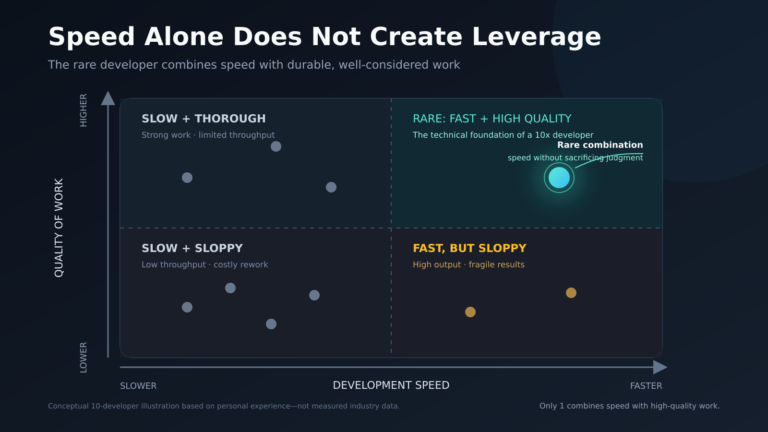
If I plotted them on a graph—with development speed on one axis and quality of work on the other—roughly 90% would fall into one of three groups.
Some developers move quickly but produce sloppy, poorly considered work. Others move slowly but produce thoughtful, high-quality code. Too often, you find developers who somehow manage to produce sloppy code slowly.
Then there is the rare fourth group: developers who work quickly while still producing high-quality, well-considered software.
They debug efficiently, anticipate architectural consequences, avoid unnecessary complexity, and recognize when an existing solution is better than building something new. They also make fewer decisions that must later be reversed.
These developers are already exceptionally valuable. Someone who consistently produces strong technical work two or three times faster than an average developer creates a meaningful advantage.
But that still does not fully explain the 10x effect.
Writing code is only one part of building a product. Someone must still understand the problem, define the desired outcome, shape the workflow, consider the user experience, account for edge cases, and decide what belongs in the first version.
In most organizations, those decisions are distributed across an entire product team.
The fast, high-quality developer is the starting point. The larger multiplier appears when that same person can make the decisions surrounding the code as effectively as they can write it.
The typical developer is expected to implement decisions that other people have already made.
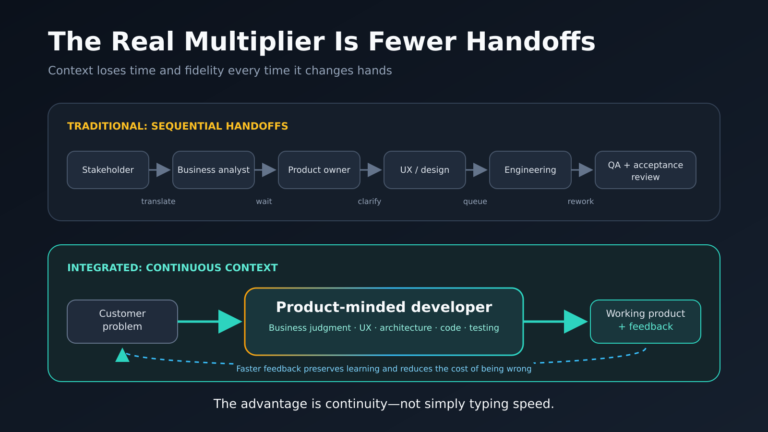
A stakeholder identifies a need → A business analyst documents it → A product owner turns it into requirements → A UX professional designs the experience → A project manager coordinates the work → The developer implements it → A quality assurance team tests it → The work then returns to the stakeholders for acceptance.
This structure is sometimes necessary, particularly in large, specialized, or highly regulated organizations. But it is also expensive.
More importantly, it reflects how most developers have been trained to work. They are given a defined solution and asked to produce the software behind it. If the requirements are incomplete, they request clarification. If a workflow has not been designed, they wait for a design. If a business decision has not been made, the work remains blocked.
Developers with meaningful business perspective are much less common.
They understand the customer, the product, the workflow, and the economics well enough to participate in—or independently make—many of those decisions. They can begin with an imperfectly stated problem, ask the right questions, determine what actually needs to be built, and carry that understanding through implementation.
A typical developer converts requirements into software.
A high-leverage developer converts problems into outcomes.
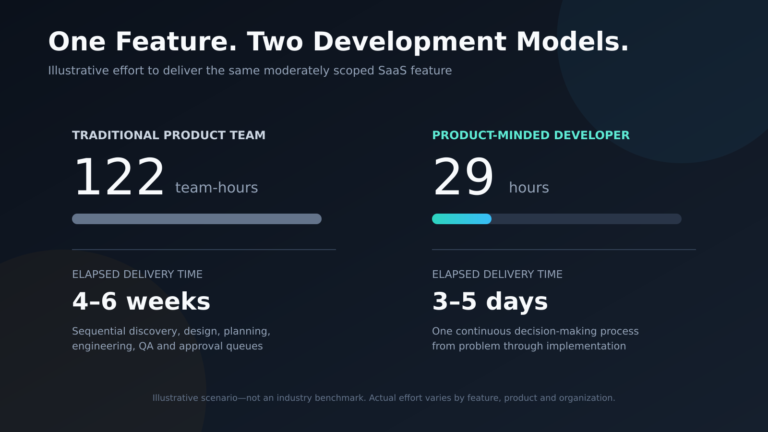
When companies calculate the cost of developing a feature, they often focus on engineering time. If a developer spends 40 hours building something, the feature appears to have required one week of work.
But the code is only the most visible portion of the cost.
The feature may also require stakeholder interviews, requirement documents, UX exploration, technical refinement, sprint planning, status meetings, design reviews, acceptance testing, and multiple rounds of clarification.
Each participant may contribute only a few hours, but those hours accumulate across the organization.
Then there is the cost that rarely appears on a timesheet: waiting.
The stakeholder meeting happens on Monday. The business analyst prepares the requirements later that week. The product owner reviews them the following week. UX adds the work to its queue. Engineering waits for an upcoming sprint. Questions discovered during development restart parts of the process.
A feature containing one week of actual engineering can potentially take four to six weeks to reach production.
This is the coordination tax: the difference between the effort required to solve a problem and the effort required to coordinate everyone involved in solving it.
Consider a moderately sized SaaS feature.
Customers need an approval workflow that allows one user to prepare content and another user to review and approve it before publication.
In a traditional product environment, the work might look something like this:
| Work involved | Traditional product team | Product-minded developer |
|---|---|---|
| Stakeholder discovery | 8 hours | 3 hours |
| Business analysis and requirements | 12 hours | Included in discovery |
| Product planning and refinement | 8 hours | 2 hours |
| UX design and revisions | 16 hours | 3 hours |
| Project and sprint coordination | 10 hours | 1 hour |
| Engineering | 40 hours | 14 hours |
| QA and acceptance | 12 hours | 4 hours |
| Clarification and rework | 16 hours | 2 hours |
| Total effort | 122 hours | 29 hours |
| Typical elapsed time | 4–6 weeks | 3–5 days |
These are illustrative numbers, not universal benchmarks. Some organizations would complete the work more efficiently, while others would require considerably more coordination.
The point is what the comparison reveals.
The product-minded developer does not need to write code ten times faster. Being approximately three times faster at the engineering portion reduces 40 hours to around 14.
The rest of the savings come from understanding the problem well enough to collapse the surrounding process.
Requirements are developed while the problem is being explored. Product decisions are made while the workflow is being considered. UX decisions are evaluated within the realities of the existing product. Testing begins with an understanding of why the feature exists rather than with a document explaining what it is supposed to do.
Instead of moving through a sequence of departments, the idea remains inside one continuous decision-making process.
Every handoff introduces three potential costs:
That lost context frequently returns as rework.
The developer builds what the ticket requested, but not what the customer needed. The finished feature goes back through review, revisions are documented, designs are updated, and the work returns to engineering.
A developer who understands the business problem preserves the chain of context from the initial idea through the finished product. They can consider business value, user experience, technical feasibility, and implementation cost at the same time.
That continuity is more valuable than typing speed.
It also creates a compounding advantage. The feature ships sooner, customers respond sooner, and the next decision is made using real feedback rather than another round of internal assumptions. Faster development creates faster learning, which reduces the likelihood of investing heavily in the wrong direction.
The result is not merely fewer hours spent building one feature. It is a more efficient product-development system.
Product owners, business analysts, project managers, UX professionals, and quality assurance engineers can all provide important expertise.
Complex products may require extensive customer research. Regulated industries may require independent review. Large systems may need dedicated coordination across multiple engineering teams. Some interfaces deserve the full attention of experienced UX specialists.
The argument is not that one developer should always replace an entire product organization.
The argument is that every feature does not inherently require every role.
Sometimes these specialists add knowledge the developer does not have. In other cases, they compensate for the fact that the developer has been separated from the customer, the business problem, or the authority to make decisions.
The highest-leverage developers understand the difference. They know when they can move independently, when they need another perspective, and when specialized expertise is essential.
Their value is not that they always work alone. Their value is that they do not require an entire process to make every decision for them.
AI will widen the gap between developers who understand only implementation and developers who understand the entire product.
A developer who needs every requirement mapped out in advance can use AI to write code faster. That is useful, but it does not eliminate the need for someone else to decide what the code should accomplish.
AI cannot compensate for missing judgment simply by producing more output. In fact, it can allow the wrong solution to be built faster.
The business-minded developer uses AI differently.
They can use it to explore solutions, prototype interfaces, produce code, generate tests, identify edge cases, review architecture, create documentation, analyze customer feedback, diagnose production issues, and prepare deployment infrastructure.
The developer remains responsible for the direction and the decisions. AI dramatically expands how much of that direction one person can execute.
This is where the economics become transformative.
In the earlier comparison, the product-minded developer reduced approximately 122 hours of organizational effort to 29 hours. With AI compressing portions of implementation, testing, prototyping, and documentation, that same feature could require even less time.
More importantly, the same person can repeat the process across an entire product.
AI gives almost every developer more production capacity. But it gives the developer with technical ability, product judgment, and business understanding the ability to build what once required a coordinated team.
The 10x developer is not a myth.
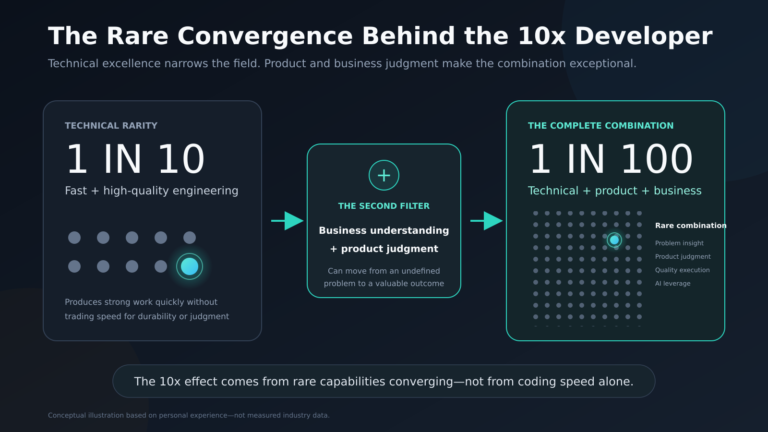
A developer who can work quickly while consistently producing thoughtful, high-quality software may already be one in ten. But even within that group, very few understand the customer, the business, the product, and the economics well enough to operate without the layers of translation and coordination surrounding most development teams.
That combination turns the one-in-ten developer into someone closer to one in a hundred.
The 10x effect does not come from one extraordinary ability. It comes from the rare convergence of technical speed, engineering judgment, product instinct, and business understanding in the same person.
AI will amplify what that person can produce, but it does not create the judgment behind it. In the hands of this unusually complete developer, however, it makes something increasingly possible: one person producing outcomes that once required an entire product team.
That is where the 10x advantage truly begins.
Jimmy Lancaster is a technologist, innovator, and entrepreneur exploring the intersection of technology, AI, SaaS, and business.
©Copyright Jimmy Lancaster. All Rights Reserved